Fall gardening tips
Shaw Nature Reserve offers these autumn gardening tips. Remove autumn leaves from tree, shrub, and flower beds. November 15 to March 15 is the best time to prune most trees and shrubs. Remove conflicting and crowded branches, dead limbs, double-leaders and unsightly branches. Drain gasoline from power equipment or use…
Nov. 5th – Wild Ones honeysuckle removal at Forest Park
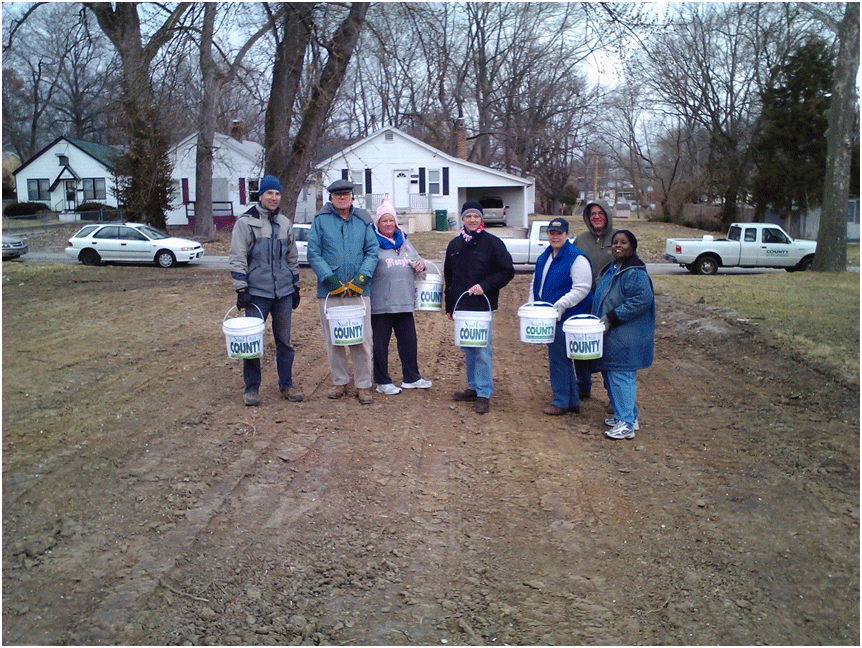
Join St. Louis Wild Ones at the 13th annual honeysuckle removal project in Forest Park, Saturday, November 5th from 9AM to noon. Forest Park Forever sponsors this project, typically with over 100 volunteers. They’ve made tremendous strides in removing large blocks of honeysuckle throughout Forest Park. In fact, there aren’t many remaining areas…
Weeds
By Bill Brighoff Last spring, a lawn care salesman came to my door and told me I had weeds in my yard, particularly white clover. I told him that I had planted the white clover in my yard, and how could it be a weed if I had purchased the seeds at a feed…
Glades, Prairies, Savannas, and Woodlands
From the Missouri Prairie Journal, Spring 2011, Volume 12, Number 1 (copied with permission) The amount of canopy cover and degree of soil development are key to determining the plant composition of each of these distinct natural communities. Glades, prairies, savannas, and woodlands are distinct natural communities, but share a great deal of the same ground flora. Differences…
CHERP leads South Campus prairie garden planting
UMSL Daily Tuesday, October 18, 2011 A team of UMSL students and faculty members and volunteers from the St. Louis community plant prairie plants on South Campus. A team of University of Missouri–St. Louis students and faculty members recently planted a prairie garden that was meant to be more than a sprucing up of South Campus….
‘Non-invasive’ cultivar? Buyer beware.
Science Daily (Oct. 7, 2011) www.sciencedaily.com/releases/2011/10/111007073214.htm Cultivars of popular ornamental woody plants that are being sold in the United States as non-invasive are probably anything but, according to an analysis by botanical researchers published in the October issue of BioScience. Tiffany M. Knight of Washington University in St. Louis, Missouri, and her coauthors at the Chicago Botanic…
Pumpkins and pollinators, a unique relationship
From The Xerces Society for Invertebrate Conservation Whether you wake to find mist hanging in damp hollows, snow draping the last of your tomato vines, or sunshine glinting off a warm sea, there is one thing that unites us all this month: pumpkins. With Halloween quickly followed by Thanksgiving, pumpkins seem to define this season….
How much do you know about spiders?
Which of the following statements are false? Spiders are insects. “Arachnid” is just a fancy name for spider. You can always tell a spider because it has eight legs. All spiders make webs. The orb web (round or “geometric” web) is a “normal” spider web. A “daddy-longlegs” is a kind…
Are your flowers deer food?
When deer are very hungry they will eat almost anything, but during the growing season they usually have lots of options. That being the case, they often eat what they like best. Following is a list of trees, shrubs, perennial flowers, and annual flowers used by North Dakota gardeners. They are grouped according to…